 JobKing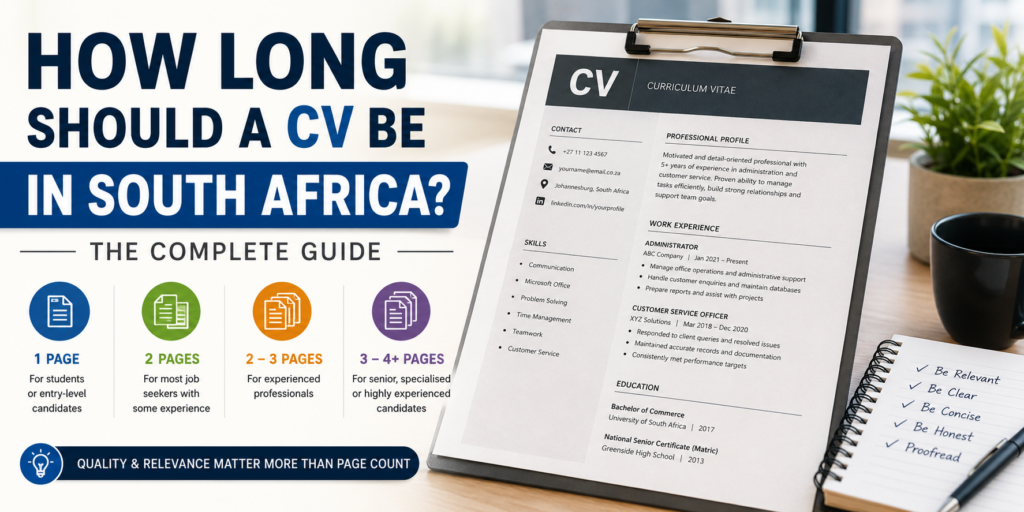
If you are applying for jobs in South Africa, one question you may have is: How long should my CV be?
Should you try to fit everything onto one page? Is a two-page CV better? Can an experienced professional submit a three- or four-page CV? And at what point does a CV become too long?
There isn’t one fixed page count that is suitable for every South African job seeker. Your ideal CV length depends on your experience, qualifications, the position you are applying for and, importantly, any instructions in the job advertisement.
However, for most job applications in South Africa, a CV of around two to three pages is a practical target. The University of Pretoria’s Career Services guidance recommends keeping a CV clear and concise and notes that two to three pages makes it easier to read. University of Johannesburg career guidance provides a slightly broader guideline of two to four pages. (University of Pretoria)
That doesn’t mean you should add unnecessary information simply to reach two pages, or remove important information just to stay below three.
The real objective is to create a CV that gives an employer enough relevant information to understand your qualifications, experience, skills and suitability for the vacancy without forcing them to search through pages of unrelated details.
This guide explains how long a CV should be in South Africa, what information deserves space on your CV, what you can remove, and how CV length should change depending on your level of experience.
Your CV has a specific job to do.
It needs to convince an employer or recruiter that you are worth considering for the next stage of the recruitment process.
The South African Department of Employment and Labour describes a CV as a document that should help convince a prospective employer of your employability and open the door to interviews. (Department of Labour)
This means your CV does not need to contain every detail about everything you have ever done.
It needs to contain the right information.
Imagine an employer is recruiting an administrative assistant and receives a large number of applications.
The employer may be looking for candidates who have:
If you have these skills, your CV should make them relatively easy to find.
A four-page CV filled with irrelevant information can actually make this more difficult than a focused two-page CV.
On the other hand, reducing a CV so aggressively that important experience disappears isn’t helpful either.
The goal is therefore not:
“Make my CV as short as possible.”
It is:
“Make my CV as relevant, clear and easy to understand as possible.”
As a general guideline, many South African job seekers can aim for approximately two to three pages.
There are exceptions.
A useful way to think about it is:
One page: May work for someone with very limited experience.
Two pages: Often suitable for entry-level and early-career candidates.
Two to three pages: A strong range for many experienced applicants.
Three to four pages: May be reasonable for applicants with extensive relevant experience, technical expertise or senior responsibilities.
Longer CVs: Sometimes necessary for specialised, executive, academic, scientific or other careers where substantial professional information must be presented.
These aren’t strict rules.
In fact, the University of Pretoria specifically advises applicants to follow the application instructions, including when an employer requests a particular CV length. (University of Pretoria)
Therefore, if an advertisement says:
“Please submit a maximum two-page CV,”
don’t send four pages simply because you normally use a four-page CV.
The employer’s instructions take priority.
Not necessarily.
A one-page CV can work particularly well for a young person, student, school leaver or someone applying for their first job.
Suppose you recently completed Matric and have:
You may not need three pages.
Trying to stretch this information across several pages could result in unnecessary content being added purely to make the CV appear longer.
Instead, a strong one-page CV could contain:
Include essential details that allow an employer to contact you, particularly your name, telephone number and professional email address.
Write a short introduction explaining who you are, the type of opportunity you are looking for and the strengths you can offer.
For example, a candidate applying for retail positions could highlight communication, reliability, customer service and willingness to learn.
Include your relevant educational background, starting with your most recent qualification.
Include genuine skills that are relevant to the position.
These could include:
Don’t simply fill this section with fashionable keywords. You should be prepared to discuss or demonstrate the skills you claim to possess.
You don’t necessarily need permanent employment to have useful experience.
The University of Cape Town’s Careers Service points out that employability skills can be developed through part-time jobs, internships, volunteering, family businesses, studies and extracurricular activities. (Careers Service)
Therefore, relevant volunteer work, casual work or community involvement may be worth including.
A one-page CV is perfectly acceptable when one page is enough to communicate your strongest qualifications.
Two pages is a particularly useful CV length because it provides enough room to explain your background without overwhelming the reader.
A two-page CV can work well for:
You could use the first page for your strongest information, including your professional profile, important skills, most recent experience and qualifications.
The second page could provide additional employment history, achievements, training, certifications and references or reference information where appropriate.
But don’t think of page two as somewhere to dump everything that wouldn’t fit on page one.
Both pages should have a purpose.
A three-page CV may be completely reasonable when you have enough relevant information to justify it.
For example, imagine you have worked for 12 years and progressed through several roles:
Trying to squeeze all of that experience into one page may remove some of the strongest evidence of your career development.
A three-page CV would give you more room to show:
Notice the repeated word: relevant.
Having 15 years of employment experience does not automatically mean every position deserves half a page.
Older and less relevant jobs can usually receive less detail, while your recent and highly relevant roles receive more attention.
Yes.
A four-page CV isn’t automatically a bad CV.
UJ career guidance recommends focusing on keeping a CV between two and four pages, while also emphasising consistency, conciseness, professional presentation, reverse chronological ordering and avoiding repeated information. (University of Johannesburg)
A four-page CV may make sense if you have substantial relevant experience.
For example:
A senior project manager might need to demonstrate experience managing large teams, budgets, projects, stakeholders and different systems.
A technical professional might need to include specialist certifications and technologies.
A senior manager might need space for leadership accomplishments and measurable business results.
The problem is not reaching four pages.
The problem is reaching four pages because you have included information that does nothing to strengthen your application.
If you have no formal work experience, aim for a focused CV rather than trying to make it appear longer.
One or two pages may be enough.
The mistake many first-time job seekers make is believing:
No job experience = nothing to put on a CV.
That isn’t necessarily true.
Think beyond permanent employment.
You may have gained relevant abilities from:
UCT notes that paid and voluntary work can help people develop transferable skills such as communication, teamwork, leadership, problem-solving, time management, adaptability and responsibility. (Careers Service)
The important part is presenting this experience truthfully.
Don’t invent a job title or employment history because you think your CV looks empty.
Instead, demonstrate your potential.
Most graduates don’t need an extremely long CV.
Around one to two pages may be sufficient for many graduates, although some candidates will legitimately need more space.
A graduate CV can focus on:
Your university qualification shouldn’t be the only reason an employer considers you.
University of Pretoria Career Services advises students to begin developing their CVs early, adding skills and work exposure while studying. It also notes that employers increasingly look for work-ready graduates with job-specific skills in addition to academic qualifications. (University of Pretoria)
Your graduate CV should therefore show what you can actually contribute.
An experienced candidate will naturally have more to say.
For many experienced professionals, two to three pages may provide enough room, while some senior or highly specialised candidates may reasonably require more.
The biggest challenge for experienced applicants is deciding what to leave out.
If you have been working for 20 years, you probably don’t need to give the same amount of space to a position you held 18 years ago as the position you currently hold.
Your recent experience is generally more valuable because it shows your current capabilities.
Consider this approach:
Provide meaningful details about responsibilities, achievements and relevant experience.
Reduce the amount of detail as the roles become older or less relevant.
In some cases, these can be summarised briefly or removed altogether if they don’t contribute to your application.
Your CV isn’t your autobiography.
It is a targeted professional document.
A recruiter won’t automatically choose Candidate A because their CV is two pages and reject Candidate B because theirs is three.
Content matters.
Consider these two hypothetical CVs.
Two pages, but filled with:
Three pages containing:
Candidate B’s extra page could be worthwhile because the information helps the employer assess the candidate.
Therefore, don’t obsess over achieving an exact page number.
Ask:
Does every section help explain why I could be suitable for this job?
If the answer is no, reconsider whether that information needs to be there.
One of the most important CV improvements has nothing to do with page count.
Stop sending exactly the same CV to every employer.
The Department of Employment and Labour recommends changing your CV so that the work goals and skills relevant to the particular job stand out more strongly. (Department of Labour)
Suppose you have experience in:
If you’re applying for an administrative position, your administrative experience should receive greater attention.
If you’re applying for a sales position, your sales achievements and customer-facing experience should become more prominent.
You don’t need to rewrite your entire life story for every vacancy.
You need to adjust the emphasis.
This rule can override almost everything else in this article.
Read the advertisement carefully.
An employer might specifically request:
If the employer asks for a two-page CV, send a two-page CV.
Following instructions is part of the application.
University of Pretoria’s Career Services specifically recommends following application instructions, including requirements such as providing a two-page CV with three references. (University of Pretoria)
Don’t lose an opportunity because you didn’t read the vacancy carefully.
Your first page is valuable.
Don’t hide your strongest selling points at the bottom of page three.
A recruiter should quickly be able to identify who you are and why you may fit the position.
Depending on your circumstances, page one could contain:
Make these clear and easy to find.
Use a short paragraph to summarise your experience, qualifications and relevant strengths.
Avoid generic statements such as:
“I am a hard-working person looking for an opportunity to grow.”
Try to provide more context.
For example:
“Administrative professional with five years of experience supporting busy office environments, including customer enquiries, data capturing, document management, scheduling and Microsoft Office.”
The second version immediately provides useful information.
Include skills that relate directly to the vacancy.
Your current or most recent relevant position should be easy to locate.
Place education where it makes sense based on your career stage.
A recent graduate may place education prominently, while an experienced professional may prioritise work experience.
Your CV may be too long when important information becomes buried under unnecessary content.
Common causes include:
If you’ve held three similar jobs, you don’t need to repeat identical bullet points word for word under all three.
Show progression or differences.
Long blocks of text make information difficult to scan.
Where appropriate, bullet points can make responsibilities and achievements easier to understand.
Your temporary weekend job from many years ago probably doesn’t need eight bullet points if you’re now applying for a senior accounting position.
Achievements can be valuable for young applicants, but experienced professionals usually don’t need extensive lists of minor school accomplishments.
Only include information that is appropriate and useful for the application.
You don’t need a paragraph explaining what “email communication” means.
Use the space for evidence of your capabilities.
No.
If your CV is three pages, don’t shrink everything until it becomes an uncomfortable two-page document.
Readability matters.
A CV with tiny text, narrow margins and almost no white space can be difficult to scan.
University of Pretoria guidance on ATS-friendly CVs recommends common fonts such as Arial or Times New Roman and advises against graphics, tables and columns for ATS-focused applications. (University of Pretoria)
The exact design can vary, but the principle is simple:
Make your CV easy to read.
Reducing the font size excessively simply to remove one page usually makes the document worse, not better.
Some organisations use Applicant Tracking Systems to process job applications.
This makes relevance and formatting particularly important.
An ATS may use information from the job description and your CV to help organise or screen applications. University of Pretoria advises applicants to use relevant keywords from the job specifications and notes that complicated graphics, tables and columns can create problems for some ATS systems. (University of Pretoria)
This doesn’t mean you should copy the entire vacancy into your CV.
Instead, make sure your CV accurately uses relevant terminology where it reflects your genuine experience.
If the advertisement requires:
Microsoft Excel
and you genuinely have Excel experience, write Microsoft Excel rather than hoping the employer understands a vague phrase such as “computer knowledge.”
If it requires:
Customer service experience
and you have it, make that experience clear.
Relevance beats keyword stuffing.
This depends on the employer’s instructions and your available space.
Some South African CV guidance includes references as a normal CV section. The Department of Employment and Labour lists references among the areas that may form part of a CV. (Department of Labour)
If an employer specifically requests references, provide them in the requested format.
Before listing somebody as a referee, ask for their permission and make sure their contact information is correct.
Good referees may include:
Avoid adding random people purely to fill the section.
If your CV has reached five or six pages and you’re struggling to shorten it, edit strategically.
Look for duties, skills or statements that appear several times.
Give your newest and most relevant roles the greatest attention.
Older positions may need only the employer, job title, dates and a brief description where appropriate.
Ask whether each item strengthens your application for this particular position.
Your introduction should be a summary, not a cover letter.
Instead of:
“I was responsible for answering the telephone and I would also assist customers who called the office with questions and provide assistance to them.”
Use something clearer, such as:
“Handled customer telephone enquiries and directed queries to the appropriate departments.”
Large graphics, unnecessary cover pages and oversized headings can consume space without adding useful information.
While unnecessary content should go, valuable achievements should stay.
Compare:
Responsible for sales.
with:
Exceeded monthly sales target by 18% over six consecutive months.
The second statement tells the employer much more.
Where possible, include evidence of your impact.
Depending on your occupation, achievements could include:
Don’t invent numbers or exaggerate achievements.
Everything on your CV should be accurate.
You don’t need to create an entirely new CV from scratch every time.
A better approach is to maintain a master CV.
Your master CV can contain your full career history, qualifications, achievements, certifications and skills.
It might be five, six or even more pages because it isn’t necessarily the version you send to employers.
When you find a vacancy, create a targeted version from your master CV.
For example:
Master CV: 6 pages
Retail application: 2 pages
Customer-service application: 2 pages
Supervisory application: 3 pages
This makes customising applications much easier.
UCT similarly recommends maintaining a baseline CV and tailoring a copy to each job so that it speaks directly to the requirements of the position. (ACDI)
Recruiters are interested in the quality of your experience, not the number of pages.
A two-page CV isn’t automatically worse than a one-page CV.
Prioritise relevant experience.
If a maximum length is specified, respect it.
A short CV isn’t a problem when you are genuinely early in your career.
Readability should not be sacrificed.
Templates can help with structure, but your experience and professional profile should accurately describe you. The Department of Employment and Labour specifically advises job seekers to write their own professional or career goals rather than simply copying material from the internet. (Department of Labour)
There is no single layout that every employer requires, but a straightforward structure could look like this:
1. Name and Contact Details
2. Professional Profile
3. Key Skills
4. Work Experience
5. Education and Qualifications
6. Training and Certifications
7. Relevant Achievements
8. Additional Relevant Information
9. References, where requested or appropriate
The Department of Employment and Labour’s CV guidance similarly identifies areas such as career goals, personal information, education and qualifications, languages, career history, interests, responsibilities, awards and references. (Department of Labour)
You don’t have to include every possible section.
Choose sections that help present your suitability for the vacancy.
Yes. A two-page CV is suitable for many South African job seekers. In fact, South African university career guidance commonly recommends concise CVs within roughly the two-to-four-page range, depending on the candidate and application. (University of Pretoria)
No. Three pages can be completely reasonable when you have enough relevant qualifications and experience to justify the space.
Not necessarily. Four pages may be appropriate for experienced or specialised candidates, although you should check whether every section is genuinely useful.
Yes. A one-page CV can work for students, school leavers, graduates and candidates with limited work history if it contains enough relevant information.
It can, particularly for specialised or senior careers, but most ordinary job seekers should first check whether older or irrelevant information can be reduced.
Not always in full detail. Recent and relevant experience usually deserves more attention than old positions that have little connection to the vacancy.
It’s better to tailor your CV. Highlight the experience, skills and qualifications that match each position. South African career guidance from the Department of Employment and Labour, UCT and UP all emphasises adapting CV content to the opportunity. (Department of Labour)
Follow the employer’s instructions. If the vacancy requests a maximum two-page CV, submit a CV within that limit.
For most South African job seekers, around two to three pages is a sensible target, but there is no universal rule saying every successful CV must have exactly two pages.
Your career stage matters.
Your industry matters.
Your experience matters.
And the employer’s instructions matter most.
A school leaver may have an excellent one-page CV.
An administrator with several years of experience may need two pages.
A manager with extensive relevant experience may need three.
A senior specialist may legitimately require four or more.
Instead of asking only, “How many pages should my CV be?”, ask a better question:
“Does my CV give an employer the most relevant information they need to decide whether I deserve an interview?”
If your CV communicates your skills, experience, qualifications and achievements clearly without unnecessary repetition, you’re moving in the right direction.
Keep it relevant. Keep it readable. Tailor it to the vacancy. Proofread it carefully. Follow the employer’s application instructions.
Ultimately, the strongest CV isn’t necessarily the shortest or the longest.
It’s the one that makes it easy for the right employer to understand why you may be the right candidate for the job.








 📢 Get Job Alerts on WhatsApp
 Home
Home View all posts
 Post a Job